
Your Personal Care Journey on the Sunshine Coast Starts Here
Arranging personal care is not a single decision. It is a sequence, and most people are somewhere in the middle of it without quite knowing where. This page walks the whole path, from the first uneasy conversation at home through to what support looks like a year in. Find the stage you are at and start reading there.
Aussie Bridge Care is a registered NDIS provider (registration 432017995) with more than 20 years in community support and workers across Maroochydore, Caloundra, Noosa, Nambour and Buderim.
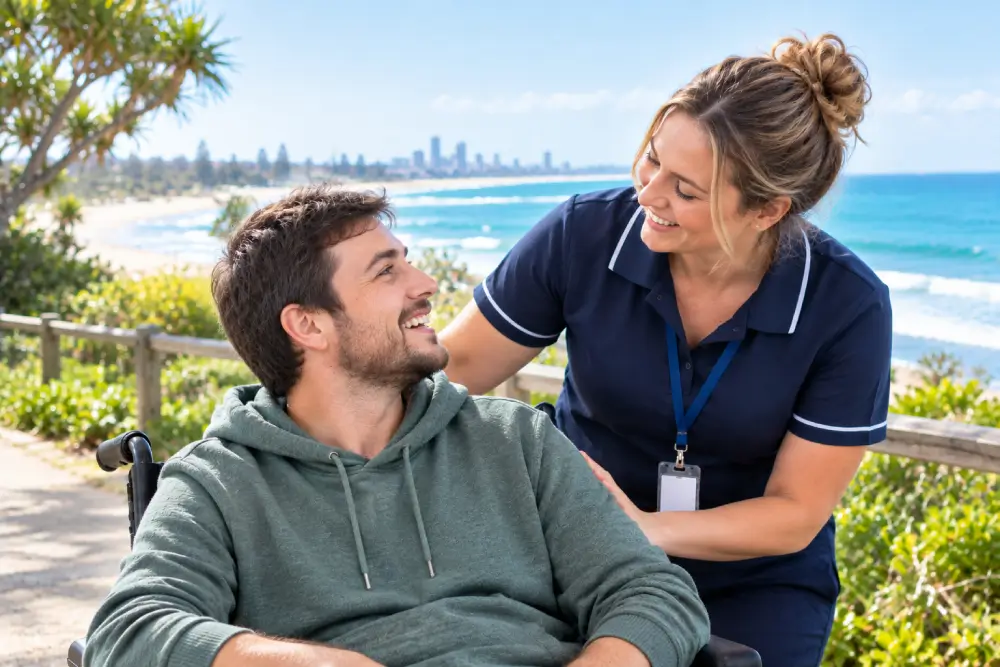
Realising Support Is Needed
There is usually no announcement. A shower starts being skipped. Someone stops going out because getting dressed takes an hour. A transfer that worked fine last year needs two people now. Or a hospital discharge letter lands assuming a level of help at home that does not exist.
Families tend to notice before they say anything, and then spend a while not saying it. That delay is normal and it is worth shortening. Personal care is not the end of independence. In practice it is the thing that keeps someone in their own home rather than having the choice made for them.
The Challenges That Come Next
Once the decision is made, a second set of problems appears.
- Working out who to trust. Personal care means someone in the bathroom. That is a different order of trust to a cleaner or a gardener.
- Understanding the funding. Your plan says "Assistance with Self-Care Activities" and you want to know whether that covers a 7am shower on weekdays.
- Coverage across a spread-out region. Caloundra to Noosa is more than an hour. Providers based at one end often cannot roster reliably at the other, and the hinterland is harder again.
- Fear of the revolving door. A different worker each week, the routine re-explained each time, and no real relationship forming.
Finding a Provider Worth Calling
Most people reach us through a support coordinator, a hospital discharge planner, or a family member who has done the searching. The first call tells you more than any website will, so it is worth listening for three things: whether the person on the phone asks about the participant before talking about the organisation, whether they give a straight answer about availability in your suburb, and whether they are willing to say no.
We would rather tell you at the first call that we cannot cover a 6am shift in Kenilworth than sign you up and disappoint you in week three.
The Free Consultation and Care Planning
A Sunshine Coast coordinator calls you back within one business day and arranges to meet, at your home, online, or at our Brisbane office. There is no cost and nothing to sign.
The meeting works through your day rather than through a form. What time do you like to get up? Do you want someone in the bathroom or in the hallway? Which parts of dressing do you want to keep doing yourself? Is there a transfer technique your occupational therapist set that we should follow exactly? Do you want a male or female worker? Is there a cultural or religious requirement we need to build around?
Those answers become the care plan. We also read your NDIS plan with you and map what you need against your line items, so you know before you commit whether the funding covers it.
Meeting Your Support Worker
We propose one or two workers, matched on four things: skill and experience for your specific needs, personality fit, language and cultural background, and your gender preference. You meet them. You choose.
Alongside your primary worker we name one or two backups and brief them on your care plan before they ever cover a shift, so a sick day does not mean starting over with a stranger. If the match is not right after a few shifts, tell your coordinator and we will find someone else. That is a normal part of the process, not a complaint.
Everyday Support in Action
What a typical day looks like, for a participant with a morning and evening roster.
Morning: hygiene and dressing
The worker arrives at the agreed time. Support out of bed, shower or bath with the level of assistance you have asked for, skin checks where these are part of the plan, drying, dressing, grooming and oral care. Compression garments and continence aids managed as set out in the plan.
Through the day: mobility and transfers
Transfers between bed, chair, shower and car using hoists, slide sheets or aids as prescribed. Where two workers are required, two are rostered.
Medication prompts
A reminder at the right time, help with a dosette pack, confirmation the dose was taken, and a flag to your coordinator if anything is missed or running low. Administration itself is a nursing task and our community nursing team covers it where that is what you need.
Meals
Shopping, cooking, portioning, and assistance at the table where eating and drinking need support. Texture-modified diets and mealtime management plans are followed as written.
Evening and overnight
Dinner, medication, the wind-down routine and settling for the night. Where overnight support is needed, that is either a sleepover shift with the worker woken for specific tasks, or an active overnight with the worker awake.
Ongoing Care and Adjustments Over Time
Needs move. A degenerative condition progresses, a recovery finishes, a family carer's own circumstances change. Support that does not move with it stops fitting fairly quickly.
We review your care plan when something changes rather than waiting for an annual prompt. If your needs increase, we help gather the shift notes and evidence you will want at a plan review. If they decrease, we scale the roster back. Respite blocks can be added when a family carer needs a break, and if support becomes constant enough that Supported Independent Living is the better funding pathway, we will say so even though it changes the arrangement.
Why This Journey Works Better With Aussie Bridge Care
| Stage | What makes the difference |
|---|---|
| First contact | A named coordinator rather than a call centre, and a straight answer about whether we can cover your suburb and hours. |
| Planning | A care plan built from your routine and read against your actual NDIS line items. |
| Matching | Four-factor matching, workers you meet before you commit, and rematching without friction. |
| Delivery | Local Sunshine Coast workers, trained in manual handling and person-centred practice, with named backups already briefed. |
| Long term | Twenty years of community support behind the service, an in-house community nursing team for when needs get complex, and pricing in line with the NDIS Price Guide. |
Who This Journey Is For
- NDIS participants who need help with self-care, from a few hours a week to several visits a day
- People living with physical, neurological, intellectual or psychosocial disability
- Participants returning home from Sunshine Coast University Hospital, Nambour General or a private hospital who need more support during recovery
- Family carers who need scheduled, dependable respite
Areas We Cover on the Sunshine Coast
Maroochydore, Caloundra, Noosa, Nambour, Mooloolaba, Buderim, Sippy Downs, Kawana Waters, Birtinya, Currimundi, Coolum Beach, Peregian, Tewantin, Palmwoods, Woombye, Beerwah and Landsborough, with hinterland suburbs arranged based on rostering.
We regularly support participants to appointments at Sunshine Coast University Hospital in Birtinya, Nambour General Hospital, Buderim Private and Noosa Hospital. Alongside personal care we deliver daily living support on the Sunshine Coast, community nursing on the Sunshine Coast, community participation on the Sunshine Coast and supported independent living on the Sunshine Coast, the full Sunshine Coast service area page lists everything.
Other Locations
Contact Info
- 07 3472 7562
- [email protected]
- Level 27, Santos Place, 32 Turbot Street Brisbane
Frequently Asked Questions
How soon can support start?
What if our needs change later?
What happens at the first meeting?
Do I have to accept the first worker you propose?
Do you cover the hinterland as well as the coast?
Can you work with my support coordinator or plan manager?
