The National Disability Insurance Scheme (NDIS) is a lifetime initiative by the Australian Government that provides support and funding to people with permanent as well as significant disabilities. It is crucial to understand the A to Z of the NDIS system for people with disability, their families, and carers to ensure tailored support that not only encourages economic and social involvement, but also boosts self-reliance. It facilitates participants with choice and control over their opted services, monetary aid for daily living needs, and special treatment enabling them to live more independently.
What Does NDIS Stand For?
NDIS stands for National Disability Insurance Scheme! It is an Australia based government funded scheme that offers long-term support and funding to the eligible individuals with significant and permanent disabilities.
Commenced in 2013, the NDIS system ensures that all the disabled participants acquire required support to gain more independence, spend quality time with their friends and family, have access to new skills, and community engagement to lead a quality life.
NDIS is built on some of the fundamental goals:
Choice & Control: Participants have complete right to choose their providers, type of support they need, and control over how they are managed.
Independence: The NDIS model prioritizes on delivering assistive tools and opportunities for skill development to let the participants live with complete independence within their community.
Operational Support: The scheme funds for the participant’s daily living support, physical or psychological therapy, and home improvements to achieve their goals.
Community Participation: A key goal is to encourage participants for direct involvement in social, community, and recreational activities to build connections and minimize isolation.
Who Is Eligible for NDIS?
Age
During application, an applicant must be below 65 years of age. Children under 9 years old are qualified for early childhood support.
Residency Requirements
Applicants need to be an Australian citizen, or live in the country, hold permanent visa, or have Protected Special Category Visa.
Disability types
A lifetime disability which might be caused by behavioral, physical, sensory, or intellectual impairments.
Functional impact
The impairment gradually minimizes the capability to participate in daily tasks including mobility, self-care, communication.
Here are some examples of who can apply for NDIS plan
- Individual with down syndrome
- Person with cerebral palsy or acute brain injury
- Someone with visual or hearing impairments
- Person with Parkinson’s disease, or emphysema
- Individual with bipolar disorder
- Children (under 9 yrs) with severe autism or developmental delays
How does the NDIS Work?
The NDIS funding system is based on necessary and reasonable support. Specific fundings are allocated under three budgets, Core Supports (flexible funding for everyday living), Capacity-Building Supports (funding for skill building), and Capital Supports (funds for costly expenses). The NDIS plans are developed in such a way that funding is provided for attaining personalised goals and removing all the impairment barriers.
What Services and Supports Does NDIS Provide?
The key supports and services NDIS offer:
Daily Living Support: Support providers assist in personal care, and home assistance for making them self-reliant.
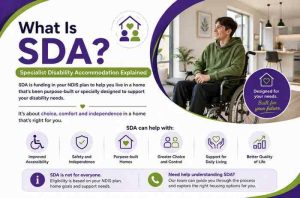
Specialist Disability Accommodation (SDA): Funding covers specially modified housing
(Widened entryways, independent living spaces, wheelchair access) for people with significant functional impairments.
Supported Independent Living (SIL): 24/7 supervision and drop-ins support for participants living in either shared or private accommodation.
Therapy: Aid for clinical support including physiotherapy, speech therapy, or occupational therapy for building functional capability. See our NDIS therapeutic supports page for how this works in practice.
Social participation, and Community Access: Assist individuals for community participation, and skill development activities.
How to Apply for NDIS?
Check eligibility on the official website of NDIS and submit an access request via call, email or post. For what happens next, read how the NDIS assesses disabilities and what an NDIS plan includes.
Prepare all the supporting documents from medical specialists and details of disabilities limits, then have the evidence form completed by a doctor. Our NDIS list of disabilities guide is a useful starting point.
Get help from support coordinators to acknowledge your plan and let the plan managers track the budget of your acquired plan.
Benefits of NDIS for Participants
Greater independence and choice
NDIS participants have control over their plan, choose service providers, and decide how to use funds.
Access to tailored supports and services
Participants can access specialized services including assistive equipment, therapies, and home modifications to achieve personal goals.
Improved quality of life and opportunities
NDIS empowers employment opportunities, community involvement, and social bonding, which results in enhanced lifestyle and greater independence.
Common Myths About NDIS
Myth: NDIS is only for children or severe disabilities
Fact: NDIS supports individuals of all ages (under 65) with extensive permanent disabilities, such as cognitive, physical, intellectual, sensory disabilities.
Myth: You lose control over your plan
Fact: NDIS is framed in such a way that participants will have complete right over choosing their providers, daily routine, plan management, and the path to achieve their end goals.
Myth: Funding covers everything automatically
Fact: Funding covers only those expenses that are directly related to the participant’s disabilities and achieve pre decided goals. Daily living expenses such as entertainment, grocery, or rent are not covered here.
FAQs About NDIS
How long does it take to get a plan?
Getting a plan usually takes up to 56 days (above 7 yrs) or 90 days (under 7 yrs) from initial application.
Can I change my plan?
Yes, absolutely! You are able to change your plan anytime depending upon the changing circumstances. For example – undergoing a life transformation or requirement of different support.
Are all supports fully funded?
No, not all supports are fully funded by NDIS. Supports that are related to the participant’s disability and achieve goals, such as – skill building, daily living supports are being funded.
Conclusion
By now, it’s clear that NDIS is designed to provide necessary funding to Australians with significant disabilities with tailored support services. Everyone deserves to lead a self-reliant life, therefore it’s inevitable to empower disabled people with greater independence, enhanced living, and control over their services. And that is where Aussie Bridge Care comes to the rescue! With us, explore a range of supports, seek practical guidance, and plan to attain personal goals for a simplified life.