If you or someone you love has a disability that makes everyday housing unsafe or unworkable, you may have come across the term SDA. It sounds simple, but it comes with strict rules, a detailed application process, and a lot of confusion around who actually qualifies.
This guide breaks down what SDA is, who’s eligible, how it’s funded, and what to expect if you’re considering applying — in plain, easy-to-follow language.
What Does SDA Stand For?
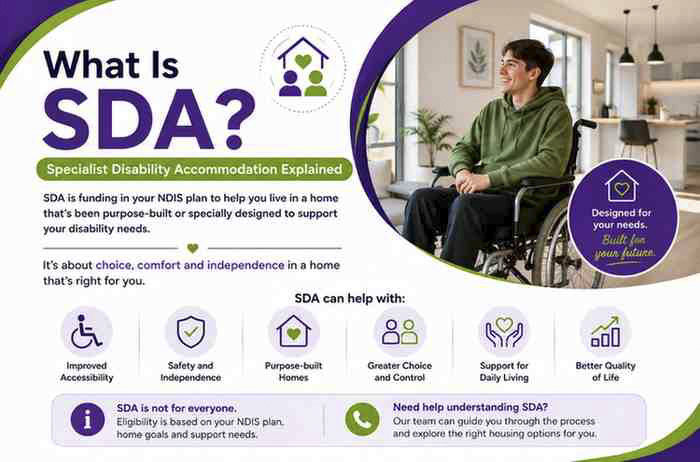
SDA stands for Specialist Disability Accommodation. It’s a category of housing funded through the National Disability Insurance Scheme (NDIS) in Australia, built specifically for people with extreme functional impairment or very high support needs.
Unlike standard housing, SDA properties are purpose-built (or significantly modified) with accessible features — things like ceiling hoists, wider doorways, wheelchair-friendly bathrooms, and emergency backup power — that make daily life safer and allow support workers to deliver care more effectively.
Importantly, SDA is a range of housing designed for people with extreme functional impairment or very high support needs, with accessible features to help residents live more independently and allow other supports to be delivered better or more safely.
Who Is Eligible for SDA?
SDA isn’t available to every NDIS participant — in fact, it’s one of the most tightly assessed supports in the entire scheme. Around 6% of all NDIS participants are eligible for SDA, making it reserved for people with the most complex housing and support needs.
To be considered eligible, the NDIA looks at whether a participant has an extreme functional impairment or very high support needs, and whether they meet the specialist disability accommodation needs requirement along with the NDIS funding criteria.
In practice, this comes down to three key questions the NDIA will assess:
- Do you have an extreme functional impairment or very high support needs? This is the highest support threshold recognized within the NDIS — generally meaning you can’t independently manage daily tasks across multiple areas of life without significant support.
- Do you have a specialist disability accommodation needs requirement? This asks whether your needs could realistically be met in standard housing with minor modifications, or whether only purpose-built SDA housing will work for you.
- Does SDA meet the NDIS “reasonable and necessary” funding criteria for you specifically? Even if you meet the first two criteria, SDA still has to be shown as reasonable and necessary for your individual circumstances.
Common Examples of Eligible Conditions
While every case is individually assessed, people who typically meet the threshold include those with a high-level spinal cord injury, a severe neurological condition, or another condition causing extreme functional impairment that requires highly specialised housing features.
Evidence You’ll Need
Eligibility isn’t just self-reported — it has to be backed by professional evidence. Typically, you’ll need reports and assessments from an occupational therapist and other allied health professionals, clearly outlining your functional impairment, your support needs, and why standard housing (even with modifications) wouldn’t be suitable.
The 4 SDA Design Categories
Not all SDA housing looks the same. It’s split into four design categories, each aimed at different needs:
| Category | Best Suited For |
|---|---|
| Improved Liveability | People with sensory or cognitive impairments who need better physical design (lighting, layout, low-stimulus environments) rather than full accessibility fit-outs |
| Fully Accessible | People with significant physical/mobility impairments who need wheelchair-accessible homes but not necessarily specialised equipment |
| High Physical Support | People with very high physical support needs, often requiring ceiling hoists, backup power, and emergency systems |
| Robust | People whose behaviours of concern require sturdier building materials and features that reduce injury risk to themselves or others |
How Is SDA Funded?
SDA funding sits in a participant’s NDIS plan under the Capital Supports budget, specifically the Specialist Disability Accommodation category. It’s not money you manage yourself — instead, it’s paid directly to your registered SDA provider as a rental subsidy covering the cost of the building itself.
A few important things to know:
- SDA pays for the home, not your support. Day-to-day support (personal care, help with meals, overnight assistance, etc.) is usually funded separately through Supported Independent Living (SIL).
- You still pay rent. Participants contribute a “Reasonable Rent Contribution,” calculated as a percentage of the Disability Support Pension and Commonwealth Rent Assistance.
- Providers must be registered. All SDA providers must be registered with the NDIS, and all dwellings must be formally enrolled, following strict design and building standards.
SDA vs. SIL vs. ILO — What’s the Difference?
This is one of the most common points of confusion:
- SDA (Specialist Disability Accommodation) = the physical home and its accessible features.
- SIL (Supported Independent Living) = the support workers and daily assistance provided inside that home.
- ILO (Individualised Living Options) = a more flexible, individually tailored living and support arrangement, often for participants who don’t need the intensive design features of SDA.
Most people who receive SDA funding will also need SIL funding in their plan to cover the actual care and support delivered day to day — SDA alone just covers the building. We unpack the difference between SIL and SDA in a separate guide, and our overview of NDIS housing options covers the alternatives for the 94% of participants who are not SDA-eligible, including disability accommodation in Brisbane.
How to Apply for SDA
- Talk to your Support Coordinator or Local Area Coordinator (LAC). They can help determine whether SDA is worth pursuing based on your situation.
- Get an occupational therapy assessment. This is the core piece of evidence the NDIA will use to assess your housing and support needs.
- Submit a Home and Living Supports Request to the NDIA, including all supporting evidence.
- Await NDIA assessment. The NDIA will review your functional impairment, support needs, and whether SDA is reasonable and necessary before including it in your plan.
- Choose a registered SDA provider and enrolled dwelling that matches your approved design category once funding is confirmed.