The quick answer
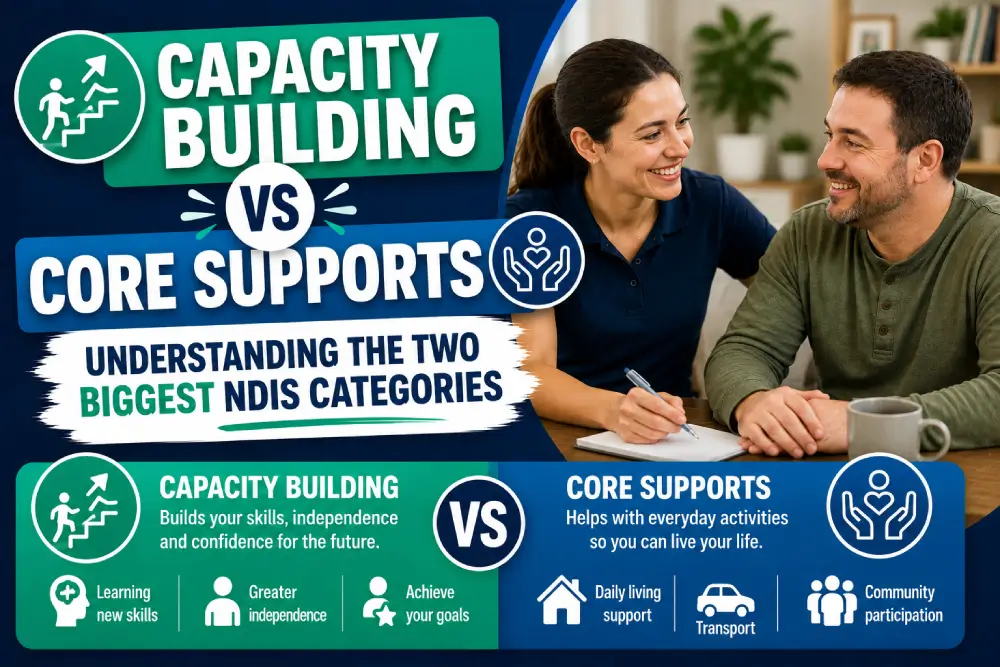
Core Supports pays for day-to-day help now. Capacity Building pays for building skills so you need less help later. Both show up in most NDIS plans. They’re not interchangeable.
The Philosophy Behind the Two Categories
The NDIS is built on a specific idea: disability support should help you maintain daily life AND build the skills, capacity, and independence that reduce reliance on support over time.
Core Supports funds the first part. Capacity Building funds the second. Both matter. Plans that only fund Core Supports miss the long-term development piece. Plans that only fund Capacity Building leave participants without enough daily help.
A good plan balances both.
What Core Supports Covers
Core Supports pays for the things you need every day — help with personal care, household tasks, community access, consumables like continence aids, and transport. The focus is on maintaining your current life. For us that is daily living support and community participation.
The four Core Supports sub-categories:
- Assistance with Daily Life
- Assistance with Social and Community Participation
- Consumables
- Transport
Core Supports is usually the largest line item in a plan. It’s the funding that keeps daily life running.
What Capacity Building Covers
Capacity Building pays for developing skills, knowledge, and capability. The focus is on making your future better — building independence, learning new skills, managing your disability more effectively.
The Capacity Building sub-categories include:
- Support Coordination — help navigating your plan and coordinating services
- Improved Daily Living — therapy and skill development (OT, physio, speech, psych) — see NDIS therapeutic supports.
- Improved Health and Wellbeing — exercise physiology, dietetics
- Improved Relationships — specialised behaviour intervention and social skills training
- Improved Learning — support transitioning to/from school or further education
- Improved Life Choices — plan management, financial capacity building
- Improved Living Arrangements — help finding appropriate accommodation
- Finding and Keeping a Job — employment support
Each sub-category has specific goals and deliverables. Unlike Core Supports, Capacity Building funding generally isn’t flexible across sub-categories.
The Key Difference — Flexibility
Core Supports funding is mostly flexible. If you have money in Assistance with Daily Life but need more community access support, you can generally shift it.
Capacity Building funding is stated. Money allocated for “Improved Daily Living” (usually therapy) can only be used for therapy. You can’t shift it to pay for support workers. You can’t shift therapy money to pay for support coordination. Our Core Supports budget guide goes deeper on the flexible side, and how to use your NDIS funding effectively covers pacing across the year.
That’s why the categorisation in your plan matters — it locks how you can spend each portion.
How They Work Together
An example participant with cerebral palsy might have:
- Core Supports — $80,000/year for a support worker helping with personal care and community access
- Capacity Building — Improved Daily Living — $12,000/year for OT and physio to maintain mobility
- Capacity Building — Support Coordination — $4,000/year for a support coordinator
The $80,000 keeps daily life running. The $12,000 builds or maintains function. The $4,000 coordinates everything. Remove any one piece and the plan doesn’t work properly.
The Biggest Confusion Point — Support Workers in Both Categories
Here’s where people get tangled up. Core Supports funds support workers for direct assistance (showering, cooking, community access). Capacity Building can ALSO fund support worker time — specifically when it’s for skill-building rather than direct assistance.
Example: A support worker teaching you to cook independently (building skills) = Capacity Building (Improved Daily Living). A support worker cooking for you (providing assistance) = Core Supports (AWDL).
The NDIS distinction is whether the goal is doing the task (Core) or learning the task (Capacity Building). In practice, the same support worker in the same shift might do both — that’s where good documentation and plan management matter.
When to Prioritise Capacity Building
Capacity Building is a forward investment. It makes sense to prioritise it when:
- You’re newer to the NDIS and building your support plan
- You’ve got goals around independence (living alone, working, studying)
- You need allied health (OT, physio, psychology) to make progress
- You’re transitioning between life stages (school to work, hospital to home)
When Core Supports Takes Priority
- Your day-to-day functioning isn’t covered without direct support
- Your support needs are stable and known, not in a skill-building phase
- You’re well past the stage where skill-building yields further independence gains
- Your disability means independence isn’t the realistic goal — stability and quality of life are
That last point matters. Not every participant has “become more independent” as a goal. For some, Capacity Building provides very little benefit and Core Supports should dominate. That’s a legitimate NDIS plan structure.
Common Capacity Building Mistakes
Three things participants often get wrong with Capacity Building:
- Not using it — Capacity Building funding that isn’t used doesn’t roll over. Therapy money unspent is therapy money lost.
- Confusing categories — trying to pay a support worker out of Improved Daily Living doesn’t work. Support workers come from Core Supports.
- Not asking for it at plan time — participants who don’t specifically request therapy or support coordination often don’t get it funded. Ask for it explicitly.
Maximising Your Capacity Building
Because Capacity Building is less flexible, plan it deliberately:
- Book therapy appointments at the start of your plan year, not the end
- Ask therapists to write reports that demonstrate progress — this supports future plan reviews
- Use support coordination hours — a support coordinator saves you time and often finds services you didn’t know existed
- Request Improved Health and Wellbeing funding if you need exercise physiology or dietetics
- If you have mental health needs, ask about psychosocial recovery coaching
When to Ask for More Capacity Building
Capacity Building is the category most often underfunded in initial plans. Situations where you should specifically ask for more Capacity Building at your next review:
- You have ongoing therapy needs that aren’t currently funded
- You want to transition into work or further education
- You’re considering independent living and need skill building
- You have psychosocial needs that would benefit from recovery coaching
- Your support needs are complex and warrant a support coordinator
We cover plan review preparation in detail in its own guide.
FAQS
Can I use Core Supports for therapy?
Not usually. Therapy sits in Improved Daily Living under Capacity Building. Using Core Supports for therapy is only allowed in specific circumstances.
What happens to unused Capacity Building money?
It doesn’t roll over. Unused funding at the end of the plan period is generally lost.
Is support coordination Core Supports or Capacity Building?
Capacity Building. Specifically, it sits under Support Coordination as its own sub-category.