Why Support Worker Quality Varies So Much
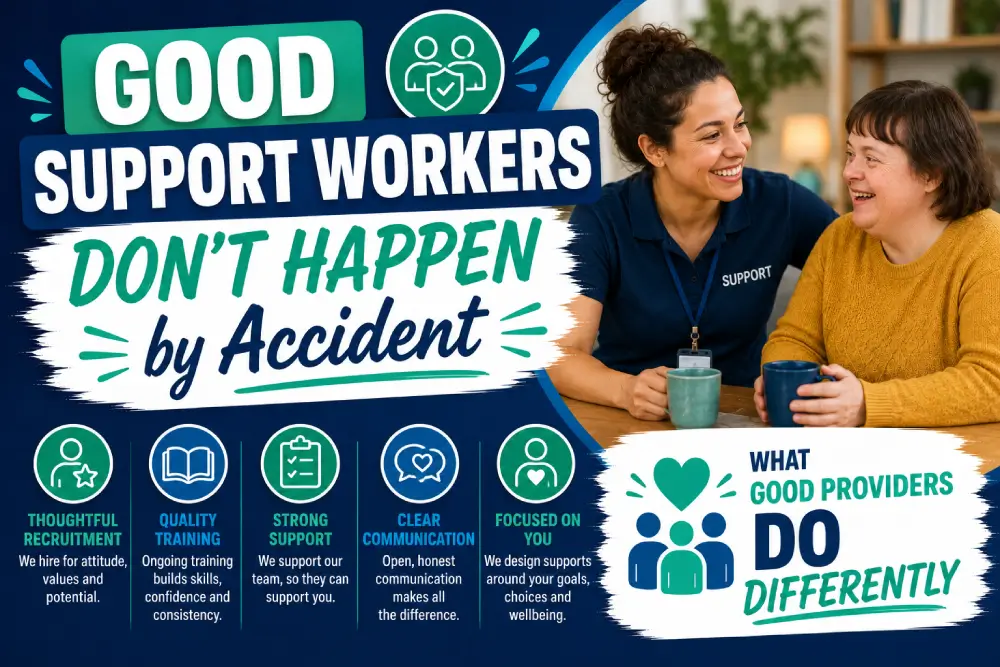
If you’ve been on the NDIS for a while, you’ve probably noticed huge variation in support worker quality — sometimes within the same provider. There are excellent workers who seem to genuinely care and exceptional at their job, sitting alongside workers who feel like they’re just getting through the shift. The difference usually isn’t the individual workers. It’s how the provider hires, trains, supports, and retains them.
Understanding how providers handle their workforce helps you pick the right one — and helps you push back when the support you’re getting isn’t what you should be getting.
What Good Providers Do in Hiring
Structured interviews, not just availability checks
Good providers interview for values and judgment, not just the right ticks on a checklist. That means behavioural questions (“tell me about a time you disagreed with a participant’s family”), scenario-based questions (“what would you do if you arrived and the participant didn’t want to shower today”), and meaningful conversation — not just “when can you start”.
Reference checks that actually happen
References are either a real process or a formality. Good providers actually call references, ask open-ended questions, and listen carefully for hesitations or gaps. Lazy providers skip reference checks or outsource them to an online checker.
Worker Screening and probity checks
Every NDIS support worker must hold a current NDIS Worker Screening Check — non-negotiable. Good providers also do additional probity (Working With Children, Blue Card, First Aid, driver’s licence, vehicle checks). They verify every document, not just record it.
What Good Providers Do in Training
Induction that takes time
A 2-hour orientation and “welcome to the team” doesn’t make anyone a competent support worker. Good providers induct new staff over 2-4 weeks with shadowing experienced workers, formal training modules, competency assessments, and gradual caseload buildup.
Ongoing training, not just compliance training
NDIS mandatory training (Worker Orientation Module, Supporting Effective Communication, Supporting Safe and Enjoyable Meals, etc.) is the minimum floor. Good providers add:
- NDIS Practice Standards training relevant to the service category
- Disability-specific training (autism, acquired brain injury, psychosocial disability, intellectual disability)
- Cultural competence training
- Manual handling refreshers
- Incident response and reporting
- Trauma-informed practice
Participant-specific training
Every new worker coming to a specific participant needs to know that participant’s care plan, communication preferences, routines, and safety considerations. Good providers train into each placement, not just at induction.
What Good Providers Do in Ongoing Support
Regular supervision
Support workers need supervision — someone who checks in on how shifts are going, what they’re finding hard, what’s working well. Good providers schedule formal supervision monthly at minimum, with additional ad-hoc support when needed.
Debriefing after difficult events
Support workers see difficult things — declines in health, relationship conflict, behaviour incidents, participant deaths. Good providers have structured debriefing for workers after these events, because unprocessed workplace stress drives turnover and reduces care quality.
Career pathway
Good providers offer genuine progression — from casual to part-time to permanent, from general support to specialist areas (community nursing, behaviour support, high-intensity support), from frontline to team leader and coordinator. Providers without progression become training grounds for workers who leave the moment they’ve gained enough experience to get a better offer elsewhere. — in our case community nursing, positive behaviour support and high intensity supports
What Good Providers Do in Retention
Fair pay and conditions
The NDIS Price Guide sets the rate the provider charges participants. The provider decides how much of that goes to the support worker. Providers who pay close to the Award minimum keep costs down but lose experienced staff. Providers who pay above Award retain quality workers — and participants experience the difference every shift.
Consistent rostering
Good providers protect worker hours — giving consistent rosters, reliable fortnightly hours, and minimal last-minute changes. Casual workers with unpredictable hours leave; permanent workers with reliable rosters stay.
Match workers to participants who suit them
Some workers thrive with SIL, others prefer community access. Some are natural with autistic participants, others connect better with older participants. Good providers place workers where they’ll succeed rather than just filling shifts. Workers who love the participants they support stay for years.
Why This Matters to You as a Participant
Support worker turnover has direct impact on you. Every new worker means:
- Retraining on your care plan
- Loss of the tacit knowledge experienced workers build up
- New relationship building from scratch
- Greater risk of errors during the learning curve
The industry average turnover for support workers is around 35% per year. At a well-run provider, it should be closer to 15-20%. You can ask — it’s a fair question and a telling one.
Questions to Ask Your Provider
- What’s your support worker turnover rate?
- How long have my workers been with you?
- What training do new workers receive before they come to me?
- How often do your workers get supervision?
- Do you have team leaders workers can escalate to?
- Do you offer career progression for support workers?
Providers who are proud of how they treat staff will answer these happily. Providers who aren’t will dodge.
Our Approach
For what it’s worth, most of our frontline support team have been with us 3+ years. We pay above Award for experienced workers. We run formal 2-week induction. We provide monthly supervision and monthly disability-specific training sessions. Our participants tell us the consistency of their workers is what they value most about our service. That’s not by accident.