Psychosocial Disability Under the NDIS
The NDIS supports participants with psychosocial disability — the functional impact of enduring mental health conditions. That’s a specific definition, and it’s not the same as “mental illness”. You can have a mental health diagnosis and not have psychosocial disability. You can also have psychosocial disability based on how a condition affects your daily life, regardless of what the diagnosis is called.
Qualifying psychosocial conditions typically include severe and enduring forms of schizophrenia, bipolar disorder, major depressive disorder, severe anxiety disorders, PTSD, and borderline personality disorder. The key is that the condition has a significant and lasting impact on your ability to function — not just a bad patch.
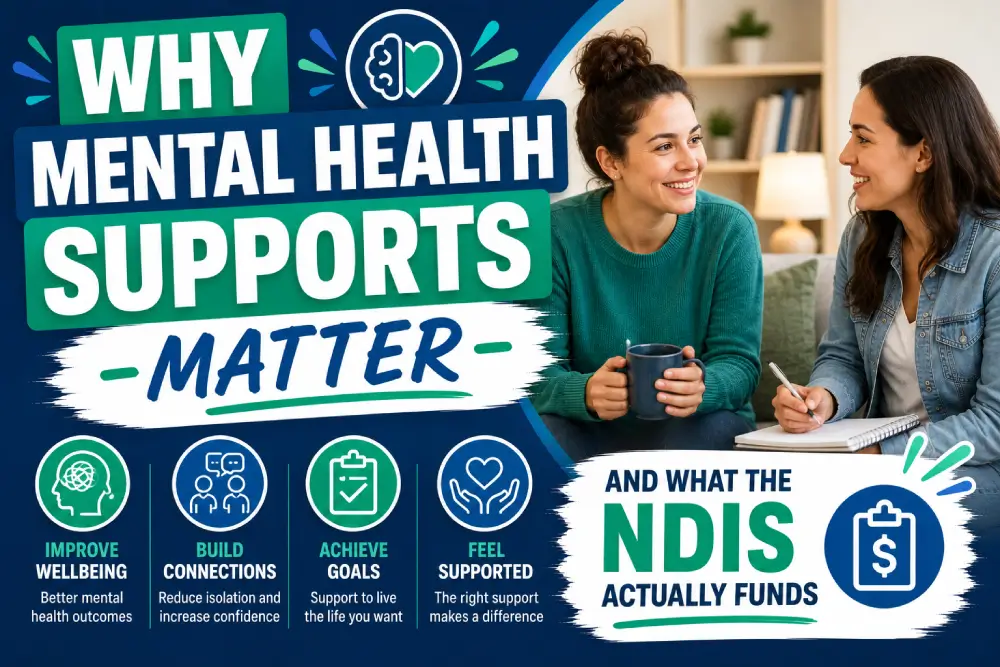
Why Mental Health Supports Are Different
Physical disability supports are often about replacement — a worker does tasks you can’t do physically. Mental health supports are different. They’re about presence, prompting, coordination, and gradual skill rebuilding. A mental health support worker doesn’t just do tasks for you. They:
- Help you actually get out of bed when depression makes that impossible
- Stay on the phone with you during anxiety spikes
- Come to your appointments with the psychiatrist when going alone feels too hard
- Help you rebuild routine after an acute episode
- Notice early warning signs and get clinical help involved before things escalate
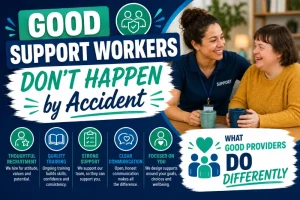
That work requires different training and different skills than physical support work. Providers who don’t take that seriously send the wrong staff into these shifts — and the wrong staff makes things worse, not better. This is the thinking behind our NDIS mental health support service.
What’s Actually Funded
NDIS mental health support breaks down into several distinct services:
Psychosocial support workers
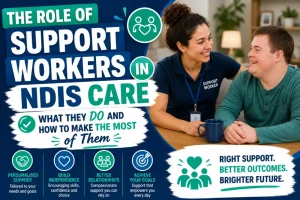
Trained support workers who provide practical support for daily living — getting out of the house, maintaining a home, attending appointments, rebuilding social connection. Funded under Core Supports (Assistance with Daily Life). In practice this overlaps with daily living support and community participation.
Recovery Coaches
An NDIS-specific funded role for participants with psychosocial disability. Recovery coaches combine NDIS plan navigation with mental health recovery principles. They help you build a recovery plan, connect to services, and coordinate across your clinical, community, and support team. Funded under Capacity Building. See psychosocial recovery coaching explained for the full picture.
Psychology and counselling (through Improved Daily Living)
Therapy is funded through Capacity Building (Improved Daily Living) if your plan includes it. Note this is different from Medicare-funded mental health sessions through a GP Mental Health Treatment Plan — which is an option that doesn’t use NDIS funding.
Community participation for psychosocial recovery
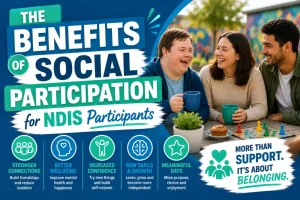
Social and community participation funding can be used to rebuild connection that’s been eroded by mental illness. Structured group programs, cultural activities, peer support, and hobby-based groups all count.
What’s NOT Funded
- Acute clinical care — hospitalisation, crisis intervention, involuntary treatment (state mental health system)
- Medication (covered under Medicare/PBS)
- Purely medical mental health treatment
- Mental health conditions that don’t meet the psychosocial disability threshold
The Recovery Framework
Good NDIS mental health support works within a recovery framework — the approach endorsed by the National Mental Health Strategy and embedded in how Recovery Coaches work. The framework isn’t about “cure”. It’s about building a meaningful life alongside a mental health condition. The core elements:
- Hope — believing recovery is possible even when symptoms are present
- Identity — developing a sense of self that isn’t defined by the condition
- Meaning — finding purpose and value in daily life
- Personal responsibility — building agency and control
- Connection — relationships and community belonging
How to Access Mental Health Supports Through Your NDIS Plan
- Get documentation of your psychosocial disability from your treating psychiatrist or GP (diagnosis, functional impact, duration)
- At your plan meeting, specifically request psychosocial supports — name the categories you want (support workers, Recovery Coach, psychology)
- Provide evidence of the daily functioning impact — what you can’t do, what causes you to struggle, what support has helped in the past
- Set recovery-oriented goals in your plan — things you’re working towards, not just deficits to manage
Early Access To Mental Health Support
One can expect long-term outcomes when they get early access to mental health support services in Brisbane.
Improves outcomes
Individuals can pursue education, maintain relationships and engage in employment opportunities when they have appropriate support.
Reduces challenges
It is easy to prevent symptoms from becoming severe when you address the mental health concerns early. This helps reduce challenges the individual might face in the long term.
Encourages independence
Individuals can take control of their mental health journey when they feel empowered. Early intervention can help in self-awareness and put the right coping strategies in place.
Not eligible for the NDIS?
Private therapists and public mental health clinics are an easy option for individuals not eligible for the NDIS to access mental health services. You can seek help from a GP to determine the most appropriate pathway for your case.
Coordinating With the Clinical Team
NDIS mental health support works alongside your clinical treatment, not instead of it. A good provider will:
- Have consent-based communication channels with your treating psychiatrist or psychologist
- Know your crisis plan and follow it
- Document interactions in a way that’s useful to the clinical team
- Escalate appropriately — knowing when to call your clinical team, your family, or emergency services
Boundaries — What Support Workers Shouldn’t Do
There are things psychosocial support workers aren’t qualified or funded to do:
- Therapy or counselling (that’s for psychologists and counsellors)
- Medication decisions (psychiatrist territory)
- Crisis clinical intervention (acute mental health services and emergency departments)
- Replacing your clinical team
Workers who overstep these boundaries — well-intentioned or not — often do harm. Good providers train staff specifically on where the line is.
The Stigma Factor
Psychosocial disability carries more stigma than most other disability categories. Participants often feel embarrassed to use NDIS supports, worry about being judged by family or the community, and undersell their support needs at plan meetings. If that’s you: the NDIS exists to fund supports for disability, including psychosocial disability. You’re entitled to the support. Claiming it isn’t weakness — it’s using the system the way it was designed.