What a Support Worker Is (And Isn’t)
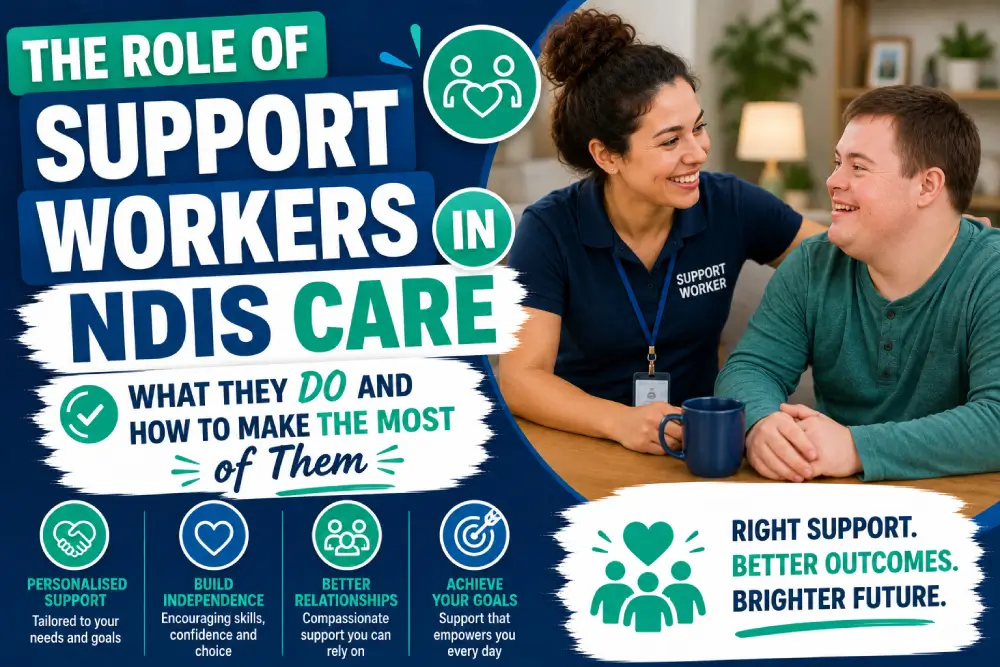
A support worker is the person who actually delivers NDIS services on the ground — showing up at your home, taking you to activities, helping with daily tasks. They’re the single most important person in most NDIS plans, because they’re the one you interact with most. Most of that work sits under daily living support and community participation.
Support workers aren’t nurses (though some have nursing backgrounds). They aren’t therapists. They aren’t case managers or support coordinators. Their role is practical support, not clinical decision-making. Understanding that distinction matters, because it shapes what you can reasonably expect. Every worker must also hold a current NDIS worker screening check before their first shift.
What a Support Worker Does
The scope varies by the category of support being delivered:
Assistance with Daily Life (AWDL) support workers
- Personal care (showering, dressing, toileting, hygiene)
- Household tasks (cleaning, laundry, meal prep)
- Medication prompts
- Mobility assistance and transfers
- Support with morning and evening routines
Community participation support workers
- Accompanying participants to activities
- Driving or navigating public transport
- Supporting engagement in group or individual settings
- Skill-building activities
SIL support workers
- All of the above, across 24-hour rostered arrangements
- Sleepover or active overnight support
- Household management in shared SIL settings (see Supported Independent Living)
- Coordination with other support workers across the roster
High-intensity support workers
- All of the above
- Plus trained delivery of specific clinical tasks (PEG feeding, tracheostomy suctioning, bowel care programs, subcutaneous injections, etc.) under documented protocols
How Support Workers Fit in the Broader Team
A well-structured NDIS team usually includes:
- Support workers — frontline delivery
- Support coordinator — plan implementation, provider coordination, issue resolution
- Allied health (OT, physio, psychology) — skill-building and clinical assessment
- Community nurse — clinical care (where needed) — our community nursing team.
- Treating medical team (GP, specialists) — medical decisions
- Family and informal supports — the unpaid but often essential layer
Support workers sit in the middle of this team. They see you most often, so they usually notice changes first — a wound looking different, a medication side effect, a shift in mood. Good support workers are the eyes and ears of the wider care team, flagging changes early to the people who can act on them.
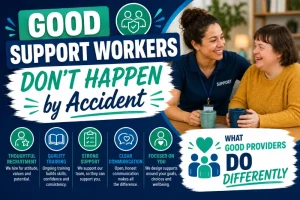
What to Expect From a Good Support Worker
- Punctual and reliable — arrives when they said they would
- Prepared — knows your care plan before they walk in
- Participant-led — lets you drive decisions rather than imposing their own preferences
- Professional boundaries — friendly but clear about the working relationship
- Documentation — writes clear shift notes that help with plan reviews and clinical handover
- Communication — tells you and your family what happened in the shift
- Confidentiality — doesn’t discuss your personal information outside the team
- Respect — treats your home, belongings, and routines with care
What a Good Support Worker Shouldn’t Do
- Give clinical or therapy advice they’re not qualified to give
- Make decisions about your plan or money without authorisation
- Cross professional boundaries (gifts, personal financial involvement, dating)
- Disclose your information to others without consent
- Push their own preferences for activities or routines
- Cut shifts short or pad timesheets
Building a Good Relationship With Your Support Worker
Be clear about what you want
Support workers can’t read minds. If something isn’t working, say so. If a new worker isn’t getting your routines right, correct them politely. The best support work relationships are the ones where you’ve told the worker what you need and they deliver it consistently.
Respect their role
Support workers are doing a job. They’re not family, they’re not friends in the traditional sense, and they shouldn’t be treated as servants. The professional relationship works best when both sides show up with mutual respect.
Provide feedback to the provider
Good feedback (positive or constructive) to the provider helps them match workers better, recognise great performance, and identify issues early. Providers rely on this feedback to coordinate well — silent frustration doesn’t help anyone.
Tell the truth about what’s changing
If your health is changing, if something has happened emotionally, if family circumstances shift — telling your support worker and provider means the support can adjust. Hiding changes until there’s a crisis makes everything harder to manage.
When the Worker Isn’t Right
Not every worker will be a good match. Signs it’s not working:
- You dread the shift instead of looking forward to it
- Communication is consistently poor
- Tasks are being missed or done wrong
- The worker seems disinterested or rushed
- Personality clash that’s not improving over time
The right thing to do: tell the provider. Request a rematch. It’s not a failure — it’s how the matching process is supposed to work. Good providers have backup workers and can rematch without drama. Our local teams — for example an NDIS support worker in Logan or an NDIS support worker in Redbank — are built with that rematching capacity in mind.
Appreciating Good Support Work
Support work is harder than most people realise. Workers deal with physical demands, emotional complexity, participant and family dynamics, documentation, and navigating changing rosters. A good worker who’s been with you for years is genuinely valuable — and worth recognising. Telling them they’re doing well, providing feedback to their provider, and building a stable working relationship benefits everyone.