What PBS Actually Means
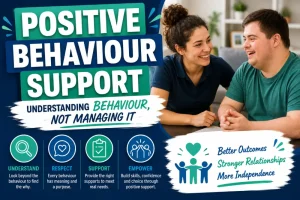
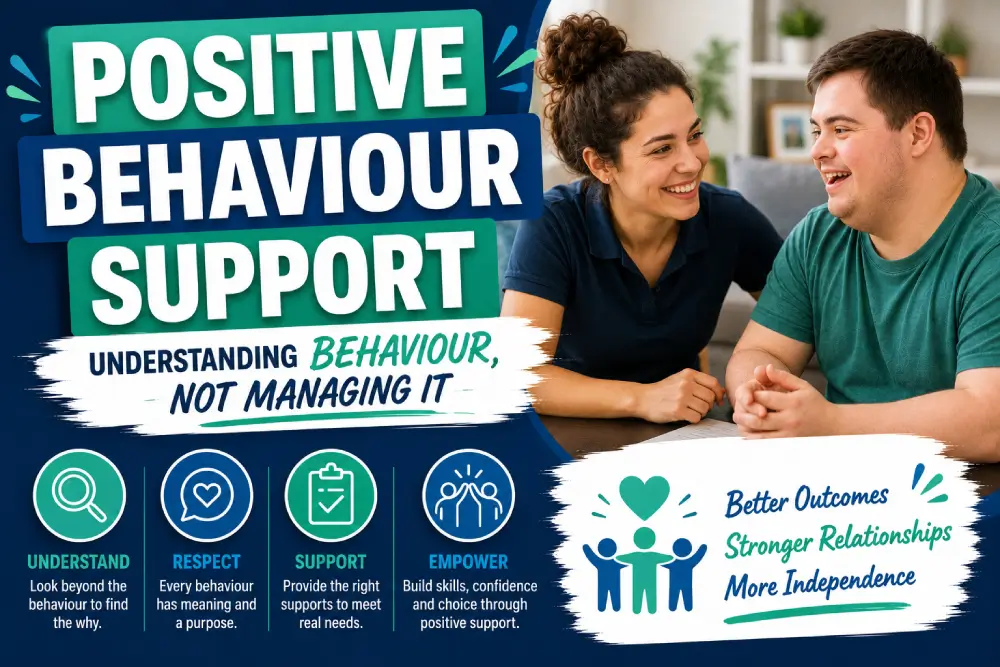
Positive Behaviour Support (PBS) is often misunderstood as a set of techniques for managing difficult behaviour. It’s not. PBS is an evidence-based approach that starts from a different question: why is this behaviour happening? What’s the person communicating, and what in their environment is driving it?
The difference matters. Behaviour “management” approaches try to suppress behaviour. PBS tries to understand it, meet the underlying need, and — over time — eliminate the conditions that make the behaviour necessary for the person.
The Core Premise
All behaviour is communication. When a person shouts, hits, withdraws, or harms themselves, they’re communicating something that can’t be communicated another way. PBS works on the assumption that:
- There’s always a reason behind the behaviour (even if it’s not obvious)
- The reason can be understood through systematic assessment
- The behaviour will reduce when the underlying needs are met through other means
- The environment (physical, relational, routine) often drives behaviour more than the person does
Who PBS Is For
- Participants whose behaviour sometimes puts themselves or others at risk
- Participants transitioning out of restrictive environments (closed facilities, hospital wards)
- Participants with autism, intellectual disability, acquired brain injury, or psychosocial disability where behaviour is part of the clinical picture
- Families and support teams struggling to respond consistently to behaviour
The PBS Practitioner Role
Under the NDIS, only registered behaviour support practitioners can develop Positive Behaviour Support Plans (PBSPs). The NDIS Quality and Safeguards Commission accredits practitioners at four capability levels:
- Core — foundation-level practitioners
- Proficient — required for plans involving restrictive practices
- Advanced — complex behaviour support situations
- Specialist — high-risk and forensic situations
Practitioners aren’t necessarily clinicians (psychologists, OTs, social workers) — they’re accredited based on specific behaviour support training, not general clinical qualifications. That accreditation process is run by the NDIS Commission, not by AHPRA. In practice a PBSP is implemented day to day by the same team that delivers a participant’s other NDIS therapeutic supports.
How a PBSP Gets Developed
Functional Behaviour Assessment
The foundation of PBS. The practitioner spends time observing the participant, interviewing family and support staff, reviewing records, and building a picture of what the behaviour is actually about. The FBA looks at:
- What happens immediately before the behaviour (antecedents)
- What the behaviour looks like specifically (topography)
- What happens after the behaviour (consequences)
- Patterns — time of day, people present, activities, environment
- Medical contributors — pain, medication side effects, sensory issues
Formulating the PBSP
Based on the FBA, the practitioner develops a PBSP with several components:
- Proactive strategies — environmental and routine changes that prevent the behaviour
- Skill-building — teaching the participant alternative ways to meet the underlying need
- De-escalation strategies — how to respond when early warning signs appear
- Response strategies — what to do if the behaviour occurs
- Any authorised restrictive practices (if clinically justified)
Staff training
The PBSP only works if the support team actually implements it consistently. That requires training — usually the practitioner delivers this directly to support workers and family. Our positive behaviour support service is built around that implementation step.
Restrictive Practices — The Hard Part
PBSPs can include restrictive practices — things that limit a person’s freedom. The NDIS regulates five categories of restrictive practice:
- Chemical restraint (medication used to control behaviour)
- Mechanical restraint (physical devices that restrict movement)
- Physical restraint (holding the person)
- Environmental restraint (locking doors, restricted access to areas)
- Seclusion (isolation from others)
Any regulated restrictive practice must be:
- Authorised under state/territory legislation
- Documented in a PBSP by a proficient-level practitioner
- Lodged with the NDIS Commission
- Reviewed and reduced over time wherever possible
The PBS framework explicitly commits to the elimination of restrictive practices wherever that’s safely possible. A good PBSP with restrictive practices should always include a plan to reduce or remove them, not just maintain them indefinitely.
What a Good PBSP Looks Like
- Specific and actionable (not vague)
- Built from real assessment data, not assumptions
- Participant-centred (the participant’s perspective is included)
- Strengths-focused (what the participant can do, not just what they struggle with)
- Reviewed regularly (at least every 12 months)
- Implemented by trained staff consistently
Red Flags — PBSPs That Aren’t Really PBS
- Punishment-based strategies (consequences designed to punish the behaviour)
- Heavy reliance on restraint without a reduction plan
- Generic templates not tailored to the specific person
- Practitioners who haven’t spent significant time observing the participant
- Plans that treat the behaviour as the problem, not as a signal
Getting a PBSP Started
If you think you or someone you support needs a PBSP:
- Check your NDIS plan for “Improved Relationships” or “Specialist Behaviour Support” funding
- If it’s not there, raise it at your next plan review with evidence of the behaviour and its impact
- Once funding is in place, engage a registered practitioner — we can recommend practitioners we work with
- Expect the full FBA and PBSP development process to take 6-12 weeks