The big picture
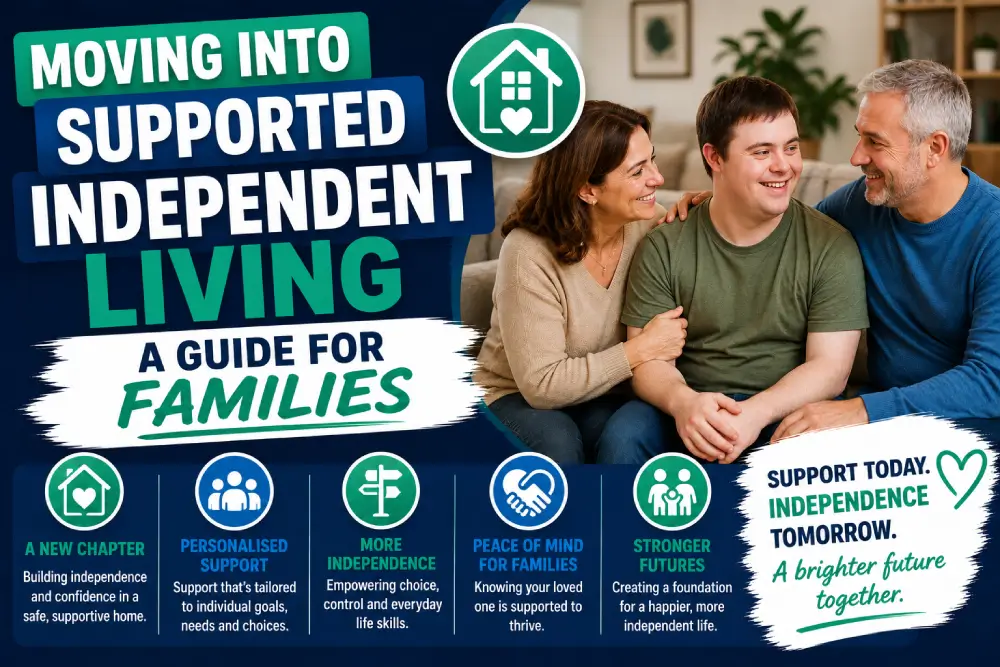
Moving into SIL is one of the most significant transitions an NDIS participant and their family will go through. Done well, it can be transformative. Done poorly, it can be destabilising for everyone. Preparation matters more than any single factor.
Why Families Consider SIL
Most families we work with don’t arrive at SIL lightly. The common scenarios:
- Parents who are aging and concerned about long-term care arrangements
- Siblings feeling overwhelmed by the primary caring role
- A participant ready for more independence than the family home can offer
- A breakdown in the family situation making change necessary
- Hospital discharge with 24/7 support needs that can’t be met at home
- Young adults transitioning from school to independent living
Each scenario brings different emotions. Parents often feel guilt alongside relief. Siblings feel responsibility alongside uncertainty. Participants themselves can feel excited, anxious, or both. All of those reactions are normal.
What SIL Actually Is
Supported Independent Living is shared accommodation where support workers are present overnight and throughout the day to help with personal care, household tasks, and daily life. Participants live with 1-4 housemates in a home, with rostered support.
SIL is different from group homes (which are older institutional models) and different from respite (which is short-term). It’s designed to be a participant’s actual home for as long as they want it to be.
Quality SIL varies hugely across providers. Some providers operate genuinely home-like environments with stable workforces and individualised support. Others operate more like shift-based institutions. Choosing the right provider is the single biggest factor in whether SIL works.
When SIL Is the Right Choice
SIL is generally a good fit when the participant:
- Needs regular support across the day and night
- Would benefit from consistent support staff and routines
- Is ready to live with others or open to living with others
- Wants more independence from family
- Has goals that involve a typical community life (work, social, recreation)
SIL is often not the best fit when:
- Support needs are very low (a few hours a week — independent living with drop-in support might be better)
- Behavioural support needs are extreme (might need specialised behaviour support housing)
- The participant strongly prefers to live alone (look at independent living with higher support hours instead)
The Funding Question
SIL funding works differently from other NDIS supports:
- It’s based on a “roster of care” — a spreadsheet of every hour of support needed each week
- The NDIS applies Price Guide rates to those hours to calculate annual funding
- Most SIL packages run between $80,000 and $500,000/year depending on support levels
- SIL funding is ringfenced — it can only be used for SIL support, not other services
- SIL funding doesn’t cover your rent, bills, food, or household costs — those come from pension and daily living contributions
Getting a SIL quote approved usually takes 2-4 months. Providers submit the roster of care to the NDIA, which assesses it and approves funding. Our guide on how to apply for SIL funding walks through that process step by step.
Finding the Right SIL Home
Questions that matter when choosing a SIL placement:
About the house
- How many housemates are there and what are their support levels?
- Is the home accessible if access needs change over time?
- What’s the neighbourhood like — transport, shops, services?
- Is there genuine private space for the participant?
About the provider
- Are workers permanent or casual? (Permanent is better for continuity.)
- How are rosters structured — consistent teams or rotating staff?
- What’s the staff:participant ratio across different parts of the day?
- How does the provider handle behavioural issues or conflicts?
- Can you meet other participants and their families?
About the match
- Are the housemates people your family member can share a home with?
- Do their routines fit together?
- Is there genuine common ground?
- How are matching decisions made?
Good providers welcome these questions and have clear answers. If a provider deflects or generalises, keep looking. You can see how we describe our own homes on our current SIL vacancies page.
The Transition Period
Most well-run SIL transitions take 3-6 months from decision to settled placement. Key phases:
Phase 1 — Exploration (4-8 weeks)
- Visit 3-5 potential SIL homes
- Meet prospective housemates and staff
- Have overnight stays where possible
- Compare providers and options openly
Phase 2 — Decision and Planning (2-4 weeks)
- Choose the preferred option
- Develop roster of care with the provider
- Submit SIL funding quote to NDIA
- Begin documenting care plans and preferences
Phase 3 — NDIA Approval (8-16 weeks)
- NDIA reviews and approves the quote
- Provider finalises roster and staffing
- Service agreement is signed
Phase 4 — Transition (2-6 weeks)
- Gradual increase in visits and stays
- Personal belongings moved in
- Full-time move
- Adjustment period with high family contact
Phase 5 — Settling (3-6 months)
- Routines establish
- Relationships with housemates and staff develop
- Gradual reduction in crisis calls and interventions
- The home starts feeling like home
The Emotional Side
Transitions into SIL are emotionally loaded for families. Common experiences:
- Parents feeling they’ve “failed” — they haven’t. Recognising what’s needed for long-term care is an act of love.
- Siblings feeling guilty for the relief they feel
- Participants homesick for the first few weeks and wanting to come home
- Family members second-guessing the decision repeatedly
- Grief about the ending of a particular family configuration
All of this is normal. Families that do best usually talk openly about these emotions, seek support (through peer networks or counselling), and give the transition enough time to prove itself.
What Ongoing Family Involvement Looks Like
Moving into SIL doesn’t mean disconnection. Most SIL homes welcome and expect regular family contact:
- Weekly or fortnightly visits
- Outings, day trips, family events
- Celebrations and birthdays
- Input into care planning and decisions
- Family represented in annual plan reviews
What changes is that the daily care is delivered by staff, not family. Which frees family to do what only family can do — be family.
How We Support Families Through the Transition
For families considering SIL with us, we offer:
- Open house visits and extended stays before commitment
- Meetings with current participants’ families
- Support through the funding quote process
- A dedicated transition coordinator during the moving weeks
- Regular family communication once the placement is settled
More about our Supported Independent Living service.
FAQS
How long before our family member is “settled”?
Most participants settle within 3-6 months, though the first 4-6 weeks can be bumpy. Some take longer; some settle almost immediately. Individual personality is a big factor.
Can we move back if it doesn’t work?
Yes. SIL placements aren’t permanent contracts. If it isn’t working after genuine attempt, you can move — to another SIL, or back home, or to a different arrangement.
How involved can we be in day-to-day decisions?
As involved as the participant wants you to be (assuming they have decision-making capacity). Most homes welcome family input but the participant is the central decision-maker.