In plain language
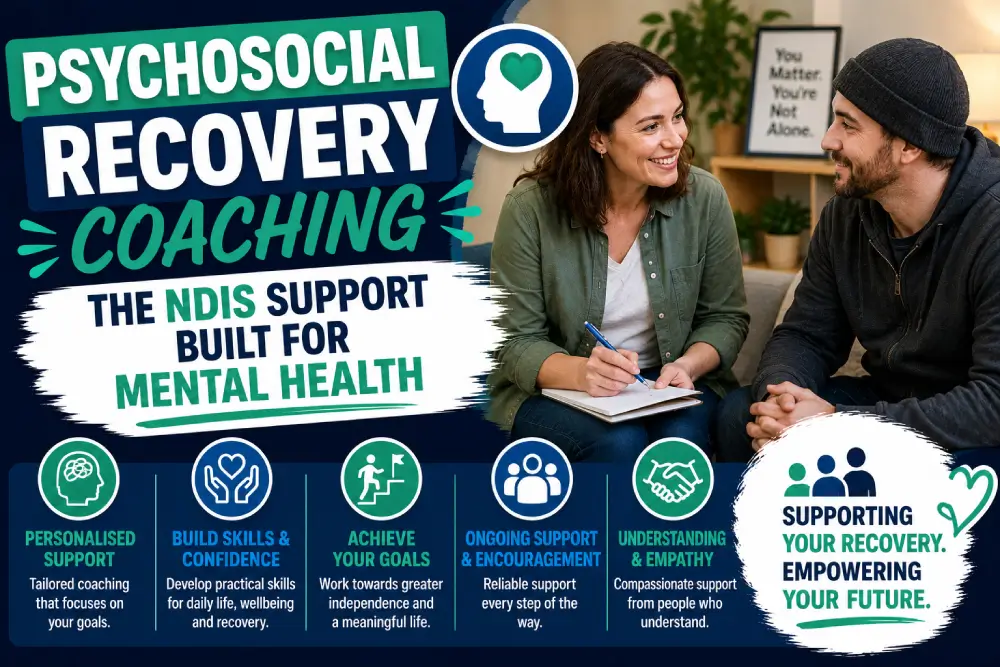
A recovery coach is a support worker with specific training in mental health recovery. They help participants with psychosocial disability build routines, manage episodes, connect with services, and move toward the life they want — a different job from clinical mental health treatment.
What Psychosocial Disability Actually Means
Psychosocial disability is the functional impact of a mental health condition — the reduced capacity to do everyday things because of how the condition affects thinking, emotion, motivation, and social functioning.
It’s not the same as “mental illness.” Many people live with mental health conditions and work full-time, have full social lives, and manage well. Psychosocial disability refers specifically to situations where the condition significantly limits daily functioning — often in episodic ways, where the person is functional during good periods and severely impaired during bad ones.
Common diagnoses underlying psychosocial disability include schizophrenia, bipolar disorder, severe depression, complex PTSD, borderline personality disorder, and severe anxiety disorders.
Why the NDIS Created Recovery Coaching
Before recovery coaching was introduced as a specific NDIS support, participants with psychosocial disability often got generic support workers who weren’t trained for mental health work. The results weren’t great — workers would struggle during crisis periods, participants would drop out of services, and long-term recovery goals got lost in day-to-day management.
Recovery coaching was designed to fix that. Coaches have specific training in:
- Mental health recovery frameworks
- Lived experience (often, though not always, from their own journey)
- Trauma-informed practice
- Episodic disability management
- Navigating the mental health system
They’re not therapists. They’re not case managers. They’re specialist support workers focused on recovery as a long-term process.
What a Recovery Coach Actually Does
A recovery coach’s work is defined by the participant’s goals, but typical activities include:
- Weekly or fortnightly 1:1 sessions (usually 1-2 hours each)
- Building and maintaining daily routines
- Support during appointments with psychiatrists, GPs, and therapists
- Coordinating care between clinical and social supports
- Skill building — managing finances, cooking, household tasks during low periods
- Crisis planning — what to do when symptoms escalate
- Community connection — reducing social isolation
- Family liaison where appropriate
- Advocacy — helping participants communicate with services they’re entitled to
The work is often quiet and steady rather than dramatic. Recovery coaching doesn’t cure mental health conditions. It builds the scaffolding around a life that lets someone live well despite them.
How Recovery Coaching Is Funded
Recovery coaching sits in the Capacity Building — Improved Relationships category of your NDIS plan, with a specific line item. The current NDIS Price Guide rates for recovery coaching are:
- Weekday — around $87/hour
- Saturday — around $122/hour
- Sunday — around $157/hour
Plans typically fund between 50 and 150 hours per year of recovery coaching depending on need.
You need recovery coaching specifically requested in your plan. It doesn’t come automatically with a mental health diagnosis — you have to ask for it at plan time, and provide evidence of psychosocial disability.
Who’s Qualified to Be a Recovery Coach?
Under the NDIS, recovery coaches need to have either:
- A relevant mental health qualification (e.g. Certificate IV in Mental Health Peer Work, Certificate IV in Mental Health)
- Or at least 2 years of lived experience working in mental health-related roles
Plus completion of specific recovery coaching training modules. Any provider should be able to tell you the qualifications of the recovery coach they’re matching you with — ask if they don’t volunteer it.
Recovery Coaching vs Support Worker vs Therapist
Three roles often get confused:
- A psychologist/psychiatrist does clinical treatment — diagnosis, therapy, medication management
- A support worker helps with day-to-day tasks — personal care, household, community access
- A recovery coach combines elements of support work with specific mental health expertise and long-term recovery focus
Participants with psychosocial disability often need all three. The recovery coach coordinates the whole picture.
When Recovery Coaching Works Well
Situations where recovery coaching tends to have significant impact:
- Recent diagnosis of psychosocial disability and need to build new routines
- Recent hospitalisation and transitioning back to community living
- Participants who are clinically stable but still limited in daily function
- Participants working toward employment or education goals
- Situations involving complex coordination of clinical and social supports
Working With Your Recovery Coach
Aussie Bridge Care does not provide recovery coaching. We provide psychosocial support workers, who work alongside you day to day. If you already have a recovery coach funded in your plan, we work with them so the recovery plan they set with you actually happens during the week: getting to appointments, building a routine that holds, staying connected with people when withdrawing would be easier.
We cover our NDIS mental health support service in detail on its own page, and the NDIS therapeutic supports that often sit alongside recovery coaching.
FAQS
Do I need a formal mental health diagnosis to get recovery coaching?
You need evidence of psychosocial disability — which usually requires a diagnosis plus evidence of how the condition affects daily functioning. A psychiatrist or psychologist can provide this.
Is recovery coaching the same as counselling?
No. Counselling is clinical therapy. Recovery coaching is practical support for living with psychosocial disability. They complement each other.
Can I change coaches if the match isn’t working?
Yes. The match is important — if it’s not working, request a change. A good provider expects this and has other coaches available.