What Community Access Actually Funds
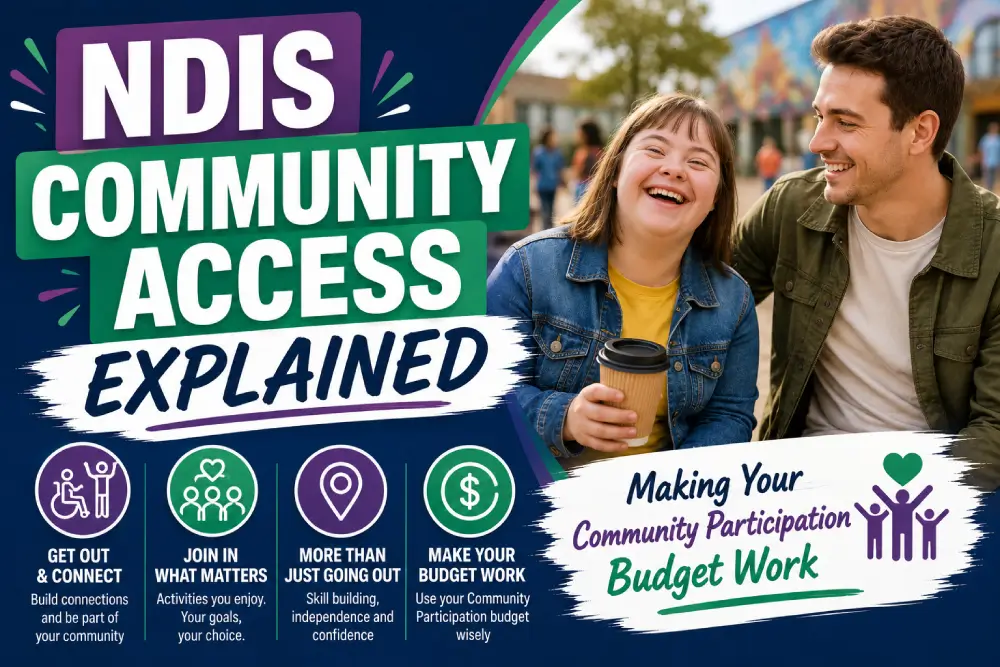
Community access — or “Assistance with Social, Economic and Community Participation” as the NDIS formally calls it — pays for support worker time when you’re out in the community. That’s the practical definition. What it actually enables is much bigger than that: the difference between being at home most of the week and having a life that goes beyond your front door.
The funding covers the support worker. Not the activity. You can use community access funding to have a worker take you to a gym, but the gym membership comes from your own money. Same for class fees, event tickets, meals when out, or cafe coffees. That distinction is important because it shapes how you plan the funding.
What Counts as “Community Participation”
Basically anything that involves being present in community life. The NDIS casts a wide net:
- Attending classes (fitness, art, education, skill-building)
- Sport and recreation (gym, swimming, walking groups, team sports)
- Social outings (cafes, meeting friends, community events)
- Cultural and faith participation (religious services, cultural events, community celebrations)
- Volunteering and community contribution
- Events (sporting, entertainment, community markets)
- Skill-building outings (shopping practice, transport practice, banking tasks)
What it doesn’t cover: holidays (the travel aspect), personal entertainment where support isn’t required, things a family member would reasonably do with you anyway.
Access Community vs Increased Community Participation
Your NDIS plan may have one or both of these sub-categories:
- Access Community (Core Supports) — direct support for being in the community now
- Increased Community Participation (Capacity Building) — skill-building programs to help you do things more independently over time
Access Community funds the day-to-day outings. Increased Community Participation funds more structured programs — confidence-building courses, transition programs for new participants, social skills workshops. Most participants with significant support needs have both.
How to Plan Community Access Hours
Most participants underuse their community access funding because they don’t have a clear plan for it. The fix: map it out monthly or quarterly. Here’s a framework:
Step 1 — List what you actually want to do
Not what sounds impressive at a plan review. What you’d genuinely choose to spend a Saturday afternoon doing. Include:
- Fixed-schedule activities (weekly classes, sports, groups)
- Regular social time (friends, family, community meetups)
- One-off events you’d like to attend across the year
- Errands and practical tasks that require support
Step 2 — Work out support needs for each
Some activities need 1:1 support. Some are fine in a group. Some you might do with minimal support once you’re there. Mapping this helps you balance expensive 1:1 hours with cheaper group hours.
Step 3 — Build a typical month
What does an average month of community access actually look like? Example for a moderately active participant:
- Weekly gym session (2 hours × 4 weeks = 8 hrs)
- Monthly arts and crafts group (4 hours × 1 = 4 hrs)
- Fortnightly cafe with a friend (2 hours × 2 = 4 hrs)
- Monthly day trip or major event (6 hours × 1 = 6 hrs)
- Weekly supermarket shop (1.5 hours × 4 = 6 hrs)
Total: 28 hours per month, or about 7 hours per week. That’s a realistic community access load for someone actively building a life.
Transport — How It’s Funded
Community access usually involves transport. There are three funding routes:
- Core Supports Transport sub-category (a fixed amount, typically used for taxi and rideshare)
- Support worker km charge (when your worker drives you in their vehicle — billed per km under NDIS Price Guide transport rules)
- Activity Based Transport (if the activity itself is the transport — e.g. a driving assessment)
Most community access participants use support worker driving most often, because it’s simpler and more flexible than coordinating taxis. The support worker’s time on the road counts as shift time.
1:1 vs Group — When to Use Each
1:1 is better when
- The activity is highly personalised (medical appointment, specific hobby)
- Your support needs are significant and shared support isn’t safe
- You’re introverted or anxious in groups
- The activity requires a specific support worker match (gender, culture, language)
Group is better when
- The activity is inherently social
- You’re trying to build peer friendships with other participants
- You want cost-efficient use of community participation hours
- Your support needs allow shared staffing safely
Building Independence Over Time
The NDIS is explicit about the purpose of community participation funding: helping participants build skills for community engagement, not creating indefinite dependence. A good provider supports you to need less support over time, not more.
A typical independence trajectory looks like:
- Month 1-3: Worker attends the full activity with you
- Month 4-6: Worker drops you off and picks up, reducing supported time
- Month 7-12: You attend with peer support from people you’ve met
- Year 2: You attend independently, using the relationships built
That trajectory isn’t always possible — participants with higher support needs often need sustained support. But for most people, the skill-building angle is realistic and should be built into the plan from the start.
Common Mistakes
- Letting the provider pick activities — it should be participant-led
- Using the funding on generic day-program filler when the participant doesn’t want it
- Failing to distinguish shift costs from activity costs (confusing what’s fundable)
- Never reviewing — the activities that worked three years ago might not fit now
- Not using the allocation — leftover funds don’t roll over
Making It Work
The practical test of whether your community access is working: does it make your week better? If yes, the plan is working. If it feels like filler or obligation, it’s time to rethink. We’ll sit down with any participant whose current community access plan isn’t delivering and help map out what it should actually look like. No charge for the conversation — call 07 3472 7562.